 CAT DASH
Cat Dash levels 1–10: learn to read the board
Learn to read the first ten Cat Dash boards: find an open exit, identify the cat blocking the next one, and clear a short chain without spending hearts.
Checked against the current 100-level set · Updated October 11, 2026
Levels 1–10 use a 7×7 board with six to eight cats. Only one or two cats can leave at the start of each puzzle. The small board is useful practice: you can inspect every path before making a move, and there is no countdown pushing you to guess.
Read one straight path at a time
Start at a cat's head and follow the direction it faces all the way to the board edge. Another cat's head, middle or tail anywhere along that line blocks the exit. Do not trace the selected cat's curved body as if it were a route to drag: a tap asks whether the line in front of its head is clear.
The numbered illustrations below label cats by the same number shown in Keyboard play. Row 1 is the top row and column 1 is the left column. These numbers identify a position in this puzzle; they are not breeds, unlock requirements or a global cat collection number.
Level 1: two entrances into the puzzle
Cat 7, at row 3, column 3, can leave upward. Cat 8, at row 6, column 6, can leave right. Both are valid opening moves. Removing Cat 7 immediately frees Cats 1 and 5, while removing Cat 8 frees Cats 2, 4 and 6. Cat 3 must still wait for Cat 4 to leave.
This is a useful first example of a branching puzzle. The illustrated solution follows one branch before the other, but you may take any currently clear exit. A successful removal only takes occupied cells away, so it cannot block a path that was already clear.
- 7×7 board
- 8 cats
- 2 opening choices
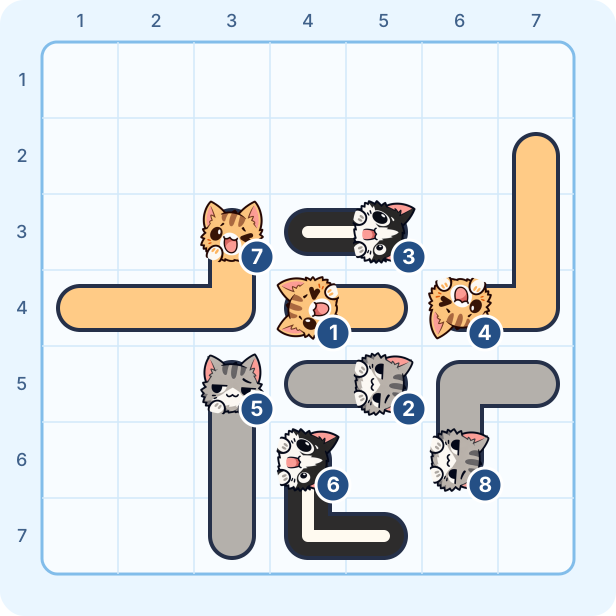
A safe start: Cat 7, Cat 8. You may choose any of these cats first.
Reveal one complete solution for level 1
Cat order: 7, 1, 5, 8, 2, 4, 3, 6.
Follow this order from a fresh board. Each step is legal in sequence. “New exits” lists cats freed by that move; an already open exit stays available. Your coat colors may differ.
| Step | Cat and head position | Facing | New exits |
|---|---|---|---|
| 1 | Cat 7 Row 3, column 3 | Up | Cats 1, 5 |
| 2 | Cat 1 Row 4, column 4 | Left | No new exit |
| 3 | Cat 5 Row 5, column 3 | Up | No new exit |
| 4 | Cat 8 Row 6, column 6 | Right | Cats 2, 4, 6 |
| 5 | Cat 2 Row 5, column 5 | Right | No new exit |
| 6 | Cat 4 Row 4, column 6 | Down | Cat 3 |
| 7 | Cat 3 Row 3, column 5 | Right | No new exit |
| 8 | Cat 6 Row 6, column 4 | Right | Board cleared |
Level 4: an open cat can lead to a longer chain
The opening choices are Cats 6 and 7. Cat 6 can leave upward without freeing another cat immediately. That is still a safe and necessary move. Cat 7 leaves downward and frees Cats 4 and 5. After Cat 4 leaves, Cats 1 and 3 become available; removing Cat 3 then frees Cat 2.
Follow the chain backward if the central cats are distracting: Cat 2 needs Cat 3 gone, Cat 3 needs Cat 4 gone, and Cat 4 needs Cat 7 gone. You have found an opening without testing a blocked cat. This backward tracing becomes useful on the larger boards later.
- 7×7 board
- 7 cats
- 2 opening choices
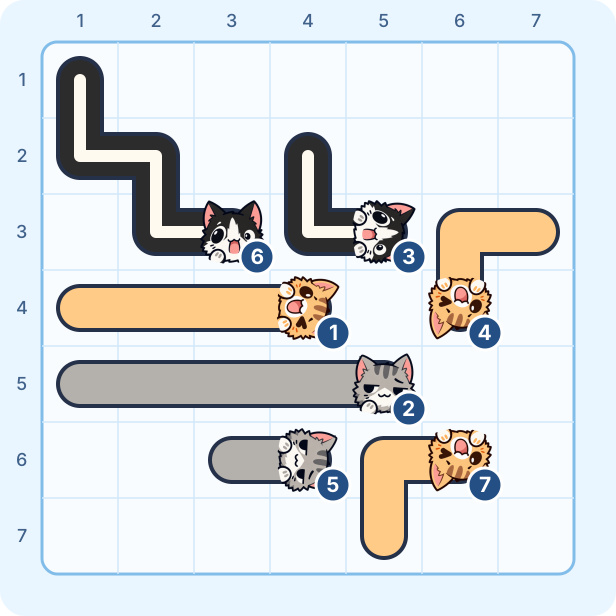
A safe start: Cat 6, Cat 7. You may choose any of these cats first.
Reveal one complete solution for level 4
Cat order: 6, 7, 4, 1, 3, 2, 5.
Follow this order from a fresh board. Each step is legal in sequence. “New exits” lists cats freed by that move; an already open exit stays available. Your coat colors may differ.
| Step | Cat and head position | Facing | New exits |
|---|---|---|---|
| 1 | Cat 6 Row 3, column 3 | Up | No new exit |
| 2 | Cat 7 Row 6, column 6 | Down | Cats 4, 5 |
| 3 | Cat 4 Row 4, column 6 | Down | Cats 1, 3 |
| 4 | Cat 1 Row 4, column 4 | Right | No new exit |
| 5 | Cat 3 Row 3, column 5 | Right | Cat 2 |
| 6 | Cat 2 Row 5, column 5 | Up | No new exit |
| 7 | Cat 5 Row 6, column 4 | Right | Board cleared |
Level 10: one opening, more than one blocker
With six cats, Level 10 has fewer pieces than Level 1, but only Cat 6 can leave initially. Its head is at row 4, column 2, facing left. Removing it frees Cat 5, whose leftward exit opens next. Cat 5's departure frees Cats 3 and 4.
Check Cats 1 and 2 again at that point: both are still blocked by Cat 3. Their original upward paths crossed two other cats, so removing Cat 5 was only part of the work. Once Cat 3 leaves, both exits are clear. Count blockers along the whole line rather than stopping at the first obstacle you notice.
- 7×7 board
- 6 cats
- 1 opening choice
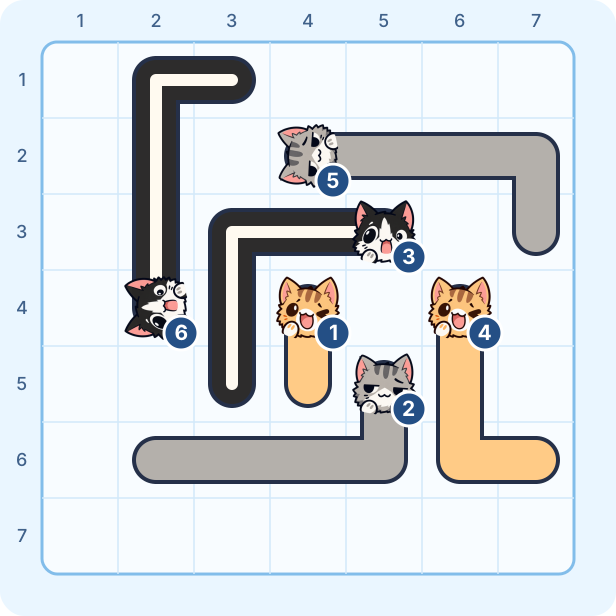
A safe start: Cat 6. You may choose any of these cats first.
Reveal one complete solution for level 10
Cat order: 6, 5, 3, 1, 2, 4.
Follow this order from a fresh board. Each step is legal in sequence. “New exits” lists cats freed by that move; an already open exit stays available. Your coat colors may differ.
| Step | Cat and head position | Facing | New exits |
|---|---|---|---|
| 1 | Cat 6 Row 4, column 2 | Left | Cat 5 |
| 2 | Cat 5 Row 2, column 4 | Left | Cats 3, 4 |
| 3 | Cat 3 Row 3, column 5 | Up | Cats 1, 2 |
| 4 | Cat 1 Row 4, column 4 | Up | No new exit |
| 5 | Cat 2 Row 5, column 5 | Up | No new exit |
| 6 | Cat 4 Row 4, column 6 | Up | Board cleared |
Build a habit before the board grows
After each exit, inspect the row or column it just cleared. If nothing obvious opens, return to the remaining cats that were already free; a move does not need to unlock another cat immediately to be useful. For a three-star replay, take as much time as you need and avoid both blocked taps and hints. A hint can help you learn a board, then Restart gives you a fresh attempt.
Continue with levels 11–30, return to the wiki index, or review the exact controls and star rules.
Every level in this range
These facts come from the current board layouts. An unblocking layer is one wave of cats that can leave after the previous wave is removed. It describes the layout, not a star requirement or a minimum number of taps.
Show the 10-level reference table
| Level | Board | Cats | Starting exits | Layers |
|---|---|---|---|---|
| 1 · example | 7×7 | 8 | 2 | 3 |
| 2 | 7×7 | 7 | 2 | 3 |
| 3 | 7×7 | 7 | 2 | 3 |
| 4 · example | 7×7 | 7 | 2 | 4 |
| 5 | 7×7 | 7 | 2 | 4 |
| 6 | 7×7 | 8 | 2 | 4 |
| 7 | 7×7 | 8 | 2 | 4 |
| 8 | 7×7 | 7 | 2 | 4 |
| 9 | 7×7 | 6 | 2 | 4 |
| 10 · example | 7×7 | 6 | 1 | 4 |