 CAT DASH
Cat Dash levels 11–30: follow the blockers
The first 8×8 boards teach you to follow several independent chains and recognize cats that need two different routes cleared before they can leave.
Checked against the current 100-level set · Updated October 11, 2026
Levels 11–30 contain eight to eleven cats on an 8×8 board. Each starts with two or three legal exits. The layouts have four or five unblocking waves: groups that become available after all the currently free cats leave. Waves describe dependencies, not how many taps you need; every cat still leaves with one successful tap.
Separate the opening branches
When you find two free cats on opposite sides, you do not have to guess which is the special correct one. Both can safely leave. What changes is the order in which you see the next exits. Following one branch for several moves can make the remaining board easier to read, but alternating between branches works too.
Use the diagrams to identify numbered cats by their head positions. The same number appears beside the breed name in Keyboard play. Rows run from top to bottom; columns run from left to right, starting at 1. The optional solutions show one checked order from the untouched board, so skip steps for cats you have already removed.
Level 11: three branches on the larger board
Cats 9, 10 and 11 can leave immediately. Cat 9 exits upward from row 3, column 3 and opens the sequence Cat 6, then Cat 3, then Cat 2. Cat 10 exits left from row 7, column 3 and frees both Cats 4 and 7. Cat 1 needs both of those cats gone before its own leftward line is clear.
The right-hand branch starts with Cat 11 moving down from row 7, column 7. That frees Cat 8, whose departure finally clears Cat 5. Notice that removing Cat 11 alone is not enough for Cat 5: Cat 8 still occupies its exit line. This is the same whole-line check introduced in Level 10, now repeated across a larger layout.
- 8×8 board
- 11 cats
- 3 opening choices
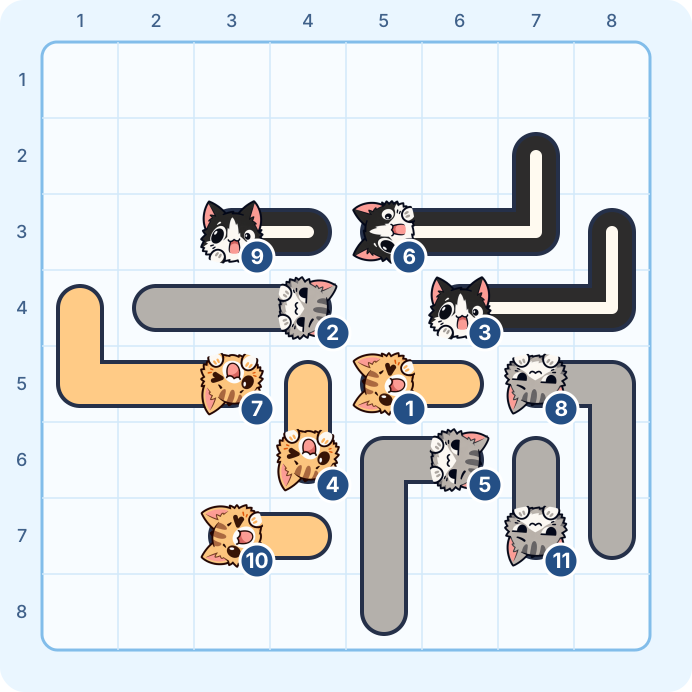
A safe start: Cat 9, Cat 10, Cat 11. You may choose any of these cats first.
Reveal one complete solution for level 11
Cat order: 9, 6, 3, 2, 10, 4, 7, 1, 11, 8, 5.
Follow this order from a fresh board. Each step is legal in sequence. “New exits” lists cats freed by that move; an already open exit stays available. Your coat colors may differ.
| Step | Cat and head position | Facing | New exits |
|---|---|---|---|
| 1 | Cat 9 Row 3, column 3 | Up | Cat 6 |
| 2 | Cat 6 Row 3, column 5 | Left | Cat 3 |
| 3 | Cat 3 Row 4, column 6 | Up | Cat 2 |
| 4 | Cat 2 Row 4, column 4 | Right | No new exit |
| 5 | Cat 10 Row 7, column 3 | Left | Cats 4, 7 |
| 6 | Cat 4 Row 6, column 4 | Down | No new exit |
| 7 | Cat 7 Row 5, column 3 | Down | Cat 1 |
| 8 | Cat 1 Row 5, column 5 | Left | No new exit |
| 9 | Cat 11 Row 7, column 7 | Down | Cat 8 |
| 10 | Cat 8 Row 5, column 7 | Down | Cat 5 |
| 11 | Cat 5 Row 6, column 6 | Right | Board cleared |
Level 20: two branches meet at the center
The eight-cat layout has two openings: Cats 7 and 8, both facing left. The upper chain is Cat 7, Cat 5, Cat 3. The lower chain is Cat 8, Cat 6, Cat 4. Cats 1 and 2 each need both Cats 3 and 4 removed before their rightward exits become clear.
If you complete the upper chain first and a central cat still will not move, do not repeat the tap. Look farther along its row for the remaining lower-branch blocker. Finishing either branch first is valid; both eventually contribute to the same two central exits.
- 8×8 board
- 8 cats
- 2 opening choices
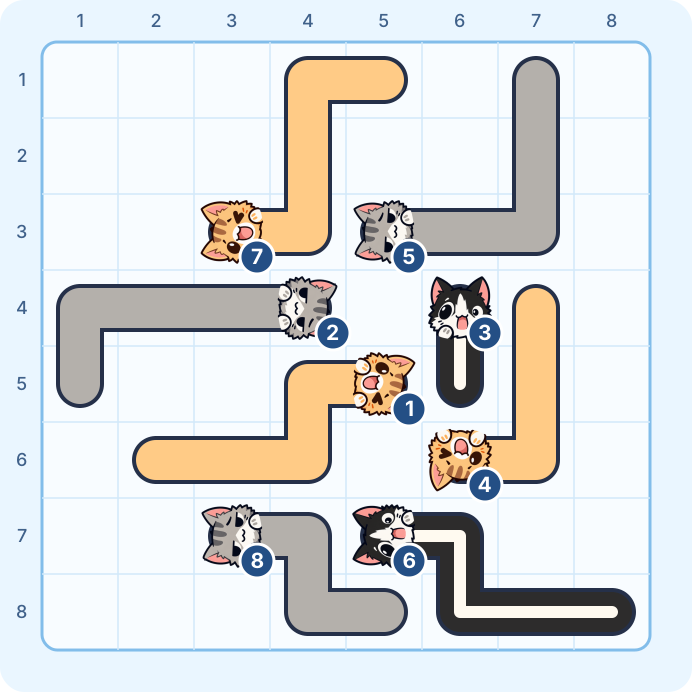
A safe start: Cat 7, Cat 8. You may choose any of these cats first.
Reveal one complete solution for level 20
Cat order: 7, 5, 3, 8, 6, 4, 1, 2.
Follow this order from a fresh board. Each step is legal in sequence. “New exits” lists cats freed by that move; an already open exit stays available. Your coat colors may differ.
| Step | Cat and head position | Facing | New exits |
|---|---|---|---|
| 1 | Cat 7 Row 3, column 3 | Left | Cat 5 |
| 2 | Cat 5 Row 3, column 5 | Left | Cat 3 |
| 3 | Cat 3 Row 4, column 6 | Up | No new exit |
| 4 | Cat 8 Row 7, column 3 | Left | Cat 6 |
| 5 | Cat 6 Row 7, column 5 | Left | Cat 4 |
| 6 | Cat 4 Row 6, column 6 | Down | Cats 1, 2 |
| 7 | Cat 1 Row 5, column 5 | Right | No new exit |
| 8 | Cat 2 Row 4, column 4 | Right | Board cleared |
Level 30: an independent exit and a five-wave chain
Cat 9 opens Cats 2, 6 and 7 at once. Cat 6 then frees Cat 3. On the lower side, Cat 10 starts a longer sequence: Cat 8, Cat 5, Cat 4. Cat 1 can leave only after both Cat 7 and Cat 4 have gone.
Cat 11, at row 5, column 8, faces right directly toward the edge. It can leave immediately and is not an initial blocker for another cat. The example solution leaves it until the end simply because its exit stays clear. Moving it first is equally valid and does not alter the star score.
- 8×8 board
- 11 cats
- 3 opening choices
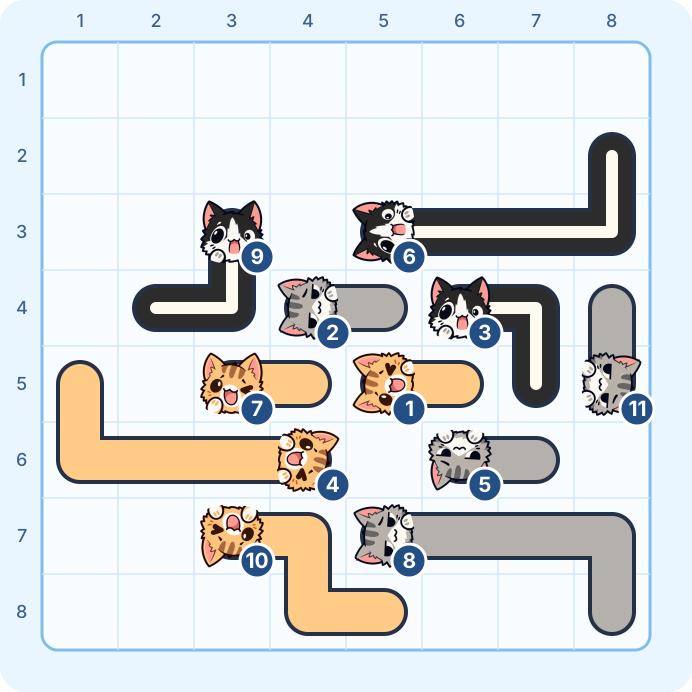
A safe start: Cat 9, Cat 10, Cat 11. You may choose any of these cats first.
Reveal one complete solution for level 30
Cat order: 9, 2, 6, 3, 7, 10, 8, 5, 4, 1, 11.
Follow this order from a fresh board. Each step is legal in sequence. “New exits” lists cats freed by that move; an already open exit stays available. Your coat colors may differ.
| Step | Cat and head position | Facing | New exits |
|---|---|---|---|
| 1 | Cat 9 Row 3, column 3 | Up | Cats 2, 6, 7 |
| 2 | Cat 2 Row 4, column 4 | Left | No new exit |
| 3 | Cat 6 Row 3, column 5 | Left | Cat 3 |
| 4 | Cat 3 Row 4, column 6 | Up | No new exit |
| 5 | Cat 7 Row 5, column 3 | Up | No new exit |
| 6 | Cat 10 Row 7, column 3 | Down | Cat 8 |
| 7 | Cat 8 Row 7, column 5 | Left | Cat 5 |
| 8 | Cat 5 Row 6, column 6 | Down | Cat 4 |
| 9 | Cat 4 Row 6, column 4 | Right | Cat 1 |
| 10 | Cat 1 Row 5, column 5 | Left | No new exit |
| 11 | Cat 11 Row 5, column 8 | Right | Board cleared |
Recognize progress even when a target stays blocked
A cat with two blockers may look unchanged after you remove one, but the board has still progressed. Inspect the remaining occupied cells in its line rather than assuming the move failed. There is no bonus for the shortest-looking order, and no time target for stars: three stars require a clear with no blocked moves and no hints. Replaying an unlocked level lets you improve a previous result without reducing your saved best.
Continue to levels 31–60, revisit the opening-board examples, or return to the wiki index.
Every level in this range
These facts come from the current board layouts. An unblocking layer is one wave of cats that can leave after the previous wave is removed. It describes the layout, not a star requirement or a minimum number of taps.
Show the 20-level reference table
| Level | Board | Cats | Starting exits | Layers |
|---|---|---|---|---|
| 11 · example | 8×8 | 11 | 3 | 4 |
| 12 | 8×8 | 9 | 2 | 4 |
| 13 | 8×8 | 11 | 3 | 4 |
| 14 | 8×8 | 11 | 2 | 4 |
| 15 | 8×8 | 11 | 3 | 4 |
| 16 | 8×8 | 11 | 3 | 4 |
| 17 | 8×8 | 11 | 3 | 4 |
| 18 | 8×8 | 9 | 3 | 4 |
| 19 | 8×8 | 9 | 2 | 4 |
| 20 · example | 8×8 | 8 | 2 | 4 |
| 21 | 8×8 | 11 | 3 | 5 |
| 22 | 8×8 | 9 | 2 | 5 |
| 23 | 8×8 | 11 | 3 | 5 |
| 24 | 8×8 | 11 | 3 | 5 |
| 25 | 8×8 | 11 | 3 | 5 |
| 26 | 8×8 | 10 | 3 | 5 |
| 27 | 8×8 | 10 | 2 | 5 |
| 28 | 8×8 | 11 | 3 | 5 |
| 29 | 8×8 | 10 | 3 | 5 |
| 30 · example | 8×8 | 11 | 3 | 5 |